data.placeholder.com/fixtures
Fixtures with answer keys
Test files for AI systems, each with the right answers and proof of where they are. Invoices and receipts as clean PDFs and phone photos, long-context haystacks with planted facts, RAG corpora with conflicting sources, small repos with planted bugs, spreadsheets with planted errors. Score your extraction, retrieval or agent against them.
| Kind | What | Items |
|---|---|---|
| documents | Invoices, receipts, contracts, payslips and more as clean PDFs plus scanned, photographed, stamped and folded images. Answers with page, quote and bounding box. | 82 |
| haystacks | 4k to 200k tokens of prose with planted facts at known depths: single needles, multiple needles, two-hop chains, near-miss distractors. | 56 |
| rag | Markdown corpora with questions: single-hop, multi-hop, aggregate, conflicting sources, false premises, unanswerable. | 2 |
| repos | Small Python, JavaScript and TypeScript projects with planted bugs and failing tests. Answers give file, line, fix and a patch. | 5 |
| spreadsheets | CSV + XLSX with wrong formulas, duplicates, hidden rows and totals that don't reconcile, plus a clean control. | 4 |
URLs
https://data.placeholder.com/fixtures                      catalog: kinds, counts, links
https://data.placeholder.com/fixtures/<kind>               items (filters below)
https://data.placeholder.com/fixtures/<kind>/<id>          item manifest
https://data.placeholder.com/fixtures/<kind>/<id>/answers  answer key
https://data.placeholder.com/fixtures/<kind>/<id>/<file>   a file listed in the manifest
https://data.placeholder.com/fixtures/<kind>/bundle.zip every item, manifests and answer keyshttps://data.placeholder.com/fixturesthe cataloghttps://data.placeholder.com/fixtures/haystacks?subkind=single&tag=32kfilter bysubkindandtag(comma = or)https://data.placeholder.com/fixtures/documents/invoice-0007a manifest: title, files with sha256, linkshttps://data.placeholder.com/fixtures/documents/invoice-0007/answersits answer key
Read-only (GET, HEAD). Version v1 is frozen: same URL, same bytes. Items, files and bundles are cached for a year (the catalog at /fixtures for an hour), and every file's sha256 is in its manifest. An unknown filter is a 400, an unknown item a 404, both JSON.
The answer-key contract
Every kind uses the same shapes, so one scorer works for all of them.
// GET /fixtures/<kind>/<id>  (manifest)
{"id": "invoice-0007", "kind": "documents", "subkind": "invoice", "version": "v1",
 "title": "…", "description": "…", "language": "en", "tags": ["…"],
 "world": {"company": "brightfjord", "refs": ["INV-2026-0007", "ACC-014"]} | null,
 "files": [{"name": "invoice-0007.pdf", "url": "/fixtures/documents/invoice-0007/invoice-0007.pdf",
            "media_type": "application/pdf", "bytes": 5945, "sha256": "…", "variant": "clean"}],
 "answers_url": "/fixtures/documents/invoice-0007/answers"}

// GET /fixtures/<kind>/<id>/answers  (answer key)
{"id": "invoice-0007", "kind": "documents", "version": "v1",
 "answers": [{"key": "invoice_number", "question": "What is the invoice number?",
              "answer": "INV-2026-0007", "type": "string", "unit": null, "tolerance": null,
              "evidence": [{"file": "invoice-0007.pdf", "page": 1, "quote": "INV-2026-0007",
"bbox": [491.6, 81.2, 556.0, 90.0], "cell": null, "line": null}]}]}typeisstring,number,money,date,boolean,listorobject. Money is a decimal string with two decimals ("1234.50") and an ISO 4217unit; dates are ISO 8601;tolerance, when set, is the allowed absolute error for numbers.evidencepoints at the proof: a page and abboxin a PDF or image, acellin a spreadsheet, alinein a text file. Quotes are verbatim.- Kinds add optional fields; ignore the ones you don't use. Evidence can have
char_offset,approx_token_offset,depth_percent,role(proof,staleorcontext),doc_id,path,hidden_row. Answers can havekind,answerable,expected_behavior,absent_terms,order_matters. Repos addpatch,failing_tests_as_shippedandnot_bugs; manifests can addquestionsandtask. worldlinks an item to records in Brightfjord, the company in a box, when it is about that company.
import json, urllib.request
BASE = "https://data.placeholder.com"
get = lambda path: json.load(urllib.request.urlopen(BASE + path))

item = get("/fixtures/documents/invoice-0007")
key = get(item["answers_url"])
pdf = urllib.request.urlopen(BASE + item["files"][0]["url"]).read()
for a in key["answers"]:
    print(a["key"], a["answer"], a["evidence"][0]["quote"])   # compare with your model's output
Documents
82 synthetic business and personal documents in English, Swedish (sv), Norwegian (nb) and German (de): invoices, receipts, bank statements, payslips, purchase orders, contracts, packing lists, insurance claims, utility bills and test reports. Every item has a clean PDF with a text layer, and most have one or more harder variants: scanned, photographed, stamped, folded.
https://data.placeholder.com/fixtures/documents[?subkind=&language=&variant=]
https://data.placeholder.com/fixtures/documents/<id>[/answers | /<file>]https://data.placeholder.com/fixtures/documentsall items, with counts per subkind, language and variant and the conventionshttps://data.placeholder.com/fixtures/documents?subkind=receipt&language=svSwedish receiptshttps://data.placeholder.com/fixtures/documents?variant=photographedeverything with a phone-photo versionhttps://data.placeholder.com/fixtures/documents/receipt-0001a Swedish grocery receipt: PDF, photo, folded scanhttps://data.placeholder.com/fixtures/documents/receipt-0001/receipt-0001-photo.jpgthe photo: perspective, uneven light, blurhttps://data.placeholder.com/fixtures/documents/receipt-0001/answersmerchant, date, total, line items, VAT breakdownhttps://data.placeholder.com/fixtures/documents/bank-statement-0001/answersa Swedish bank statement (PDF and a folded scan)https://data.placeholder.com/fixtures/documents/purchase-order-0005/purchase-order-0005-photo.jpga German purchase order, photographedhttps://data.placeholder.com/fixtures/documents/contract-0001/contract-0001-scanned.pdfa two-page contract, scanned to an image-only PDFhttps://data.placeholder.com/fixtures/documents/bundle.zipall 82 items (about 19 MB)
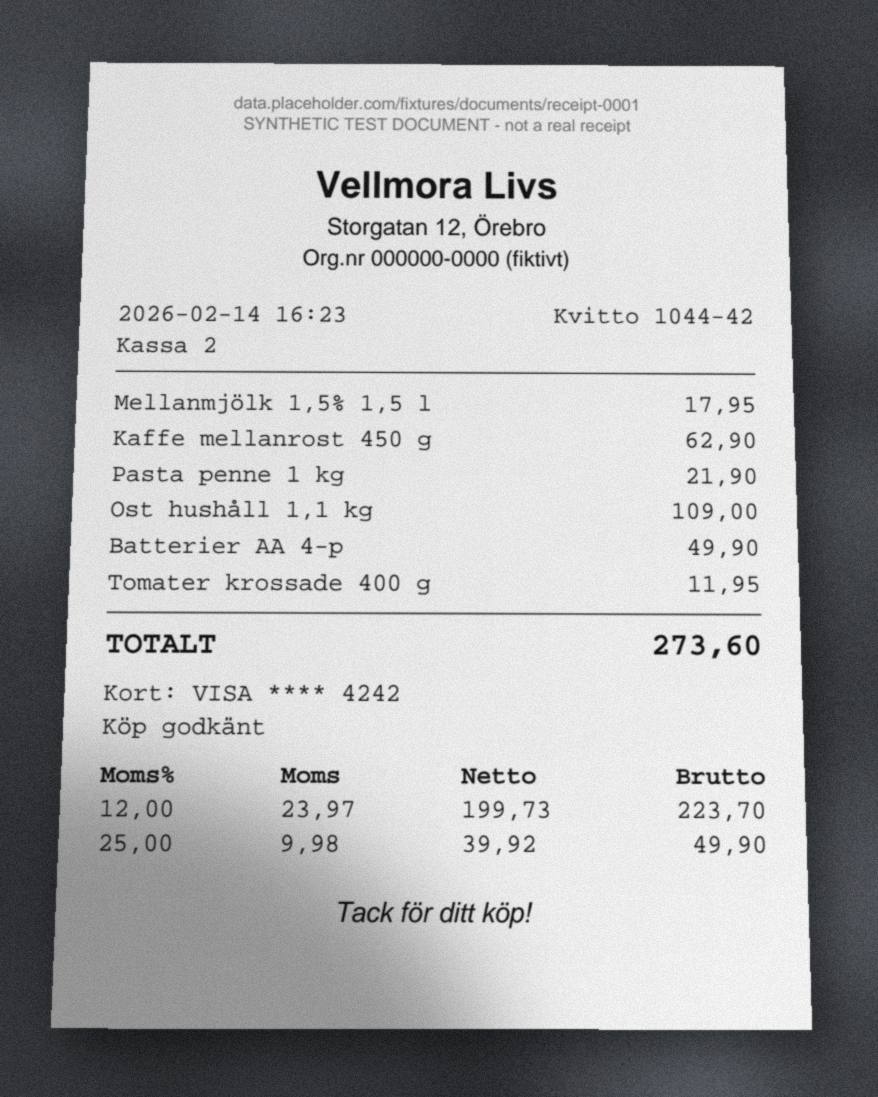
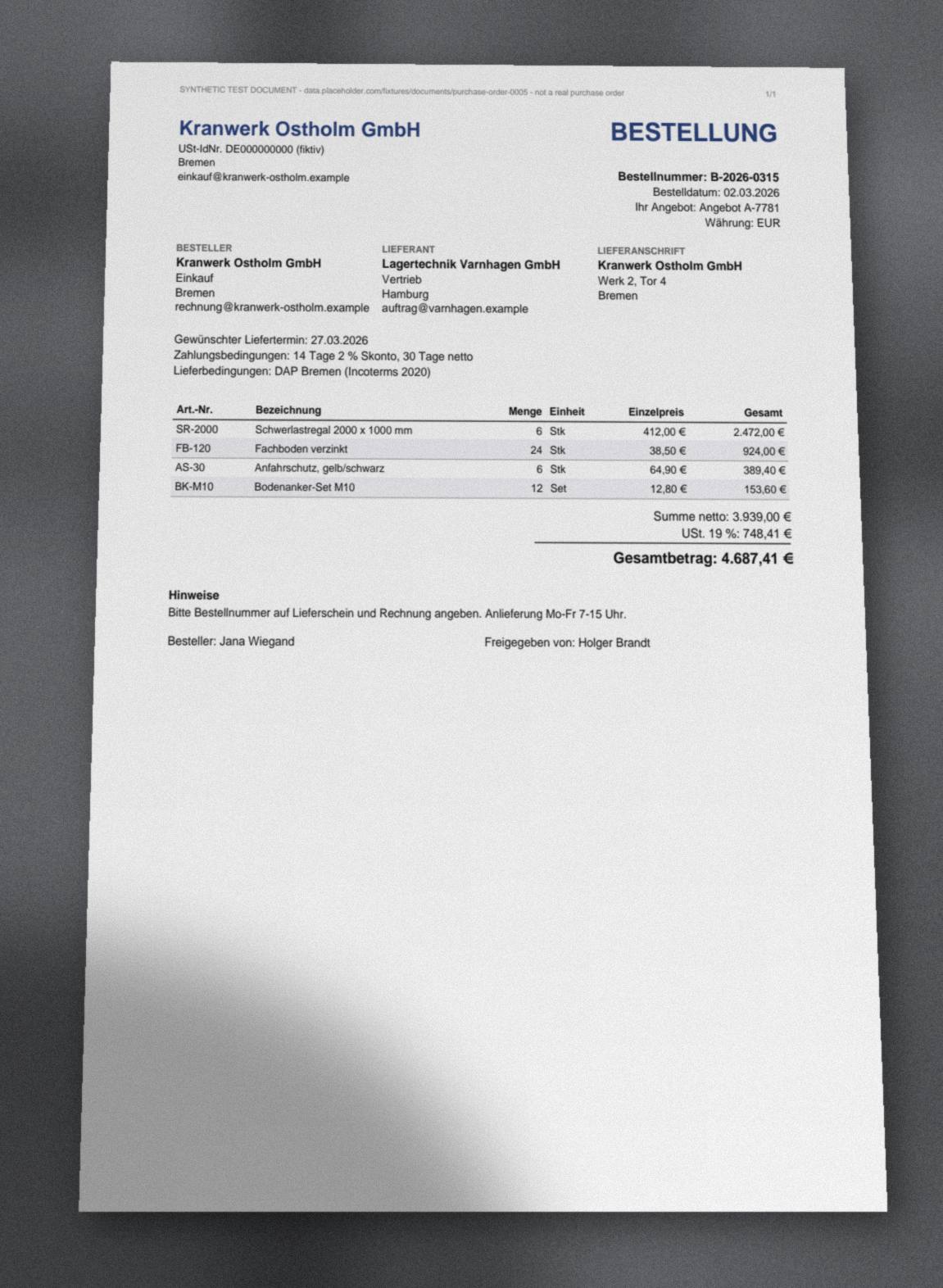
bboxis[x0, y0, x1, y1]from the top-left.bbox_unitssayspt(PDF points) orpx(pixels of that image). Image boxes are the PDF boxes mapped through the variant's distortion, so they can be slightly loose.- Every answer has evidence in the clean PDF. Image variants repeat the evidence for page 1; stamp and handwritten-note answers only exist in the stamped image.
- Documents print local number and date formats; answers are normalised (
"273.60"withunit: "SEK","2026-02-14"). - Brightfjord invoices refer to real records in the company dataset (
world.refs).
Haystacks (long context)
Seeded almanac prose with planted facts. IDs follow a fixed pattern, so you can build a depth-by-length sweep without listing them:
| ID | What |
|---|---|
needle-<size>-d<depth> | One fact at depth 000, 025, 050, 075 or 100 percent |
multi-<size> | Several facts spread through the text |
chain-<size> | Two-hop: the answer needs two facts that point at each other |
distractor-<size> | One fact plus near-misses that look like it |
Sizes: 4k, 8k, 16k, 32k, 64k, 128k, 200k tokens. Token counts are estimated as characters ÷ 4; real tokenizers give roughly 3.5 to 4.5 characters per token. The evidence gives line, character offset, approximate token offset and depth percent.
https://data.placeholder.com/fixtures/haystacks/needle-32k-d050manifest with the questionhttps://data.placeholder.com/fixtures/haystacks/needle-32k-d050/needle-32k-d050.txtthe text (about 129 KB)https://data.placeholder.com/fixtures/haystacks/needle-32k-d050/answersanswer, line 267, 50% depthhttps://data.placeholder.com/fixtures/haystacks/chain-128k/answersa two-hop chain at 128k
RAG corpora
Two corpora of Markdown files, each also as one corpus.jsonl (id, file, source, title, date, text per line) and a questions.json.
brightfjord-workplace: 109 documents (wiki pages, e-mail threads, tickets, chat channels) from the Brightfjord company, with stale and conflicting statements. 27 questions.quillmoor-support-kb: an appliance support knowledge base with near-duplicate articles. 20 questions.
Answers have a kind (single-hop, multi-hop, aggregate, conflicting, false-premise, unanswerable) and an expected_behavior: answer, abstain or correct-premise. Unanswerable questions have answer: null, expected_behavior: "abstain" and absent_terms: words that appear nowhere in the corpus. For conflicts, evidence is marked proof or stale, so you can check the model picked the newer source.
https://data.placeholder.com/fixtures/rag/brightfjord-workplacemanifest: task, questions, 111 fileshttps://data.placeholder.com/fixtures/rag/brightfjord-workplace/corpus.jsonlthe whole corpus, one document per linehttps://data.placeholder.com/fixtures/rag/brightfjord-workplace/answersanswers with quotes and line numbers
Repos with planted bugs
Five small projects as ZIP files: py-invoicing, py-booking, py-logstats, js-cart, ts-ratelimit. As shipped, some tests fail; with the documented fixes, all pass. The manifest has the task, the test_command and the file list. The answer key has one answer per bug (file, line, category, the exact before/after fix and the failing tests), a unified patch, and not_bugs: things that look like defects but aren't (such as a TODO), so a fix there is a false positive.
https://data.placeholder.com/fixtures/repos/py-invoicingmanifest: task,python3 -m unittest discover -s tests -t . -vhttps://data.placeholder.com/fixtures/repos/py-invoicing/py-invoicing.zipthe codehttps://data.placeholder.com/fixtures/repos/py-invoicing/answersbugs, fixes and the patch
Spreadsheets
Each item is the same sheet as XLSX (with formulas) and CSV: sales-ledger-q1, expenses-2026-03, inventory-count, and orders-clean, a control with no planted problems. Answer keys give the number of problems, the affected cells, each problem with its cell reference and exact content, and the corrected totals.
https://data.placeholder.com/fixtures/spreadsheets/sales-ledger-q1/sales-ledger-q1.xlsx60 orders, ten planted problemshttps://data.placeholder.com/fixtures/spreadsheets/sales-ledger-q1/sales-ledger-q1.csvthe same as CSVhttps://data.placeholder.com/fixtures/spreadsheets/sales-ledger-q1/answerswrong reference, duplicate row, outlier, number stored as text, hidden row…
Everything is synthetic. Names, companies and numbers are invented; domains end in .example and identifiers come from test ranges. Use these to test and score, not as real records.